Working principle
How the duty is performed.
A buffer is a flow decision
The tank decouples two stages that do not share the same instantaneous flow. Start with the measured peak and minimum rates, the allowable hold time and the control response. A vessel sized from a nominal line capacity can be too large, keeping product waiting longer than the process allows.
Mixing is a product decision
Formulation may require ingredient addition, dispersion or a defined blend time. Agitation then has to achieve homogeneity without whipping in air or damaging texture. A gentle recirculation loop, a slow agitator and a high-shear mixer are different process choices, not cosmetic options.
The vessel is also a hygiene decision
Headspace, venting, spray coverage, drain slope, dead legs and instrument pockets determine whether the tank can be cleaned and emptied. A tank placed on a sterile route needs a validated sterile boundary; the vessel alone does not make the product sterile.
Mechanical composition
What the machine is made of.
A stainless vessel with the working volume, headspace and outlet geometry required by the duty.
Selected for homogeneity, ingredient addition and the acceptable shear and air entrainment.
A jacket, insulation or recirculation loop where the product condition must be held.
Measured values for control, alarms and the batch record.
Spray access, drain point, vent or filter and a route for displaced air.
An outlet that can be emptied by the connected pump without starving or trapping product.
Product-contact material grade, surface finish, drive rating and connection sizes are stated on the offered drawing. We do not publish guessed values as verified specifications.
Configuration matrix
Compare the choices, not just the machine name.
| Configuration | Best fit | What changes |
|---|---|---|
| Surge / buffer tank | A measured flow mismatch between refining, treatment or filling. | Adds usable volume and level control; agitation may be intermittent or unnecessary. |
| Agitated mixing tank | A formulation step with approved ingredients and a defined blend. | Adds homogeneity control; agitator type, speed and air entrainment must be trialled. |
| Jacketed temperature-controlled tank | A product that must be held at a defined temperature before the next stage. | Adds heat-transfer surface and control; hold time and temperature uniformity still need evidence. |
| Sterile or aseptic hold | A validated aseptic process that requires a protected hold point. | Only meaningful as part of the sterile boundary; it is not a standalone preservation step. |
Project data sheet
What to fix before a model is quoted.
| Project parameter | Why it changes the selection | Your value / unit |
|---|---|---|
| Working volume | Sets the usable buffer time, not the nominal vessel size | litres or kg; level range |
| Peak and minimum flow | Defines fill/empty rates and the control response | kg/h; range |
| Hold time and turnover | Limits product exposure and sets the operating window | minutes at normal flow |
| Agitation / formulation | Determines homogeneity, shear and air entrainment | Duty; ingredient addition |
| Temperature and cleaning | Sets jacket, insulation, spray access and drain route | °C; method |
This is a briefing sheet, not a catalogue specification. The offered model, motor rating, dimensions and connection sizes are issued on the approved drawing.
Banana conditions
What the feed must tell us.
- Measured peak and minimum flow at the tank inlet and outlet.
- Normal and maximum hold time, including stops and changeovers.
- Batch size and whether the vessel is continuous or batch-fed.
- Formulation, ingredient order and required homogeneity.
- Product viscosity and temperature at filling and discharge.
- Cleaning method, drain route and access for inspection.
- Available floor area and headroom for the vessel and agitator.
Process position
Upstream and downstream.
Place the tank where the process needs hold-up or formulation. Do not use it to hide a persistent upstream or downstream imbalance; the cause still has to be corrected.
Cleaning & access
- Confirm spray coverage of the headspace, walls and outlet.
- Provide a drain point at the lowest part of the vessel and pipework.
- Avoid dead legs at instruments, vents and sample points.
- Define how the agitator, baffles and manway are inspected.
Safety & operation
- Interlock agitator access and vessel entry with the drive and product supply.
- Guard the agitator drive and provide a safe working platform.
- Protect against overpressure or vacuum where the vessel design requires it.
- Provide a safe route for hot product, cleaning chemicals and displaced air.
Trial & acceptance
- Measure fill and discharge rates over a normal production cycle.
- Record the actual hold time at minimum and maximum level.
- Check homogeneity, air entrainment and temperature at agreed sample points.
- Observe drain-down and cleaning access after the run.
- Confirm the control response when the downstream stage stops.
Equipment views
Structure and connections.
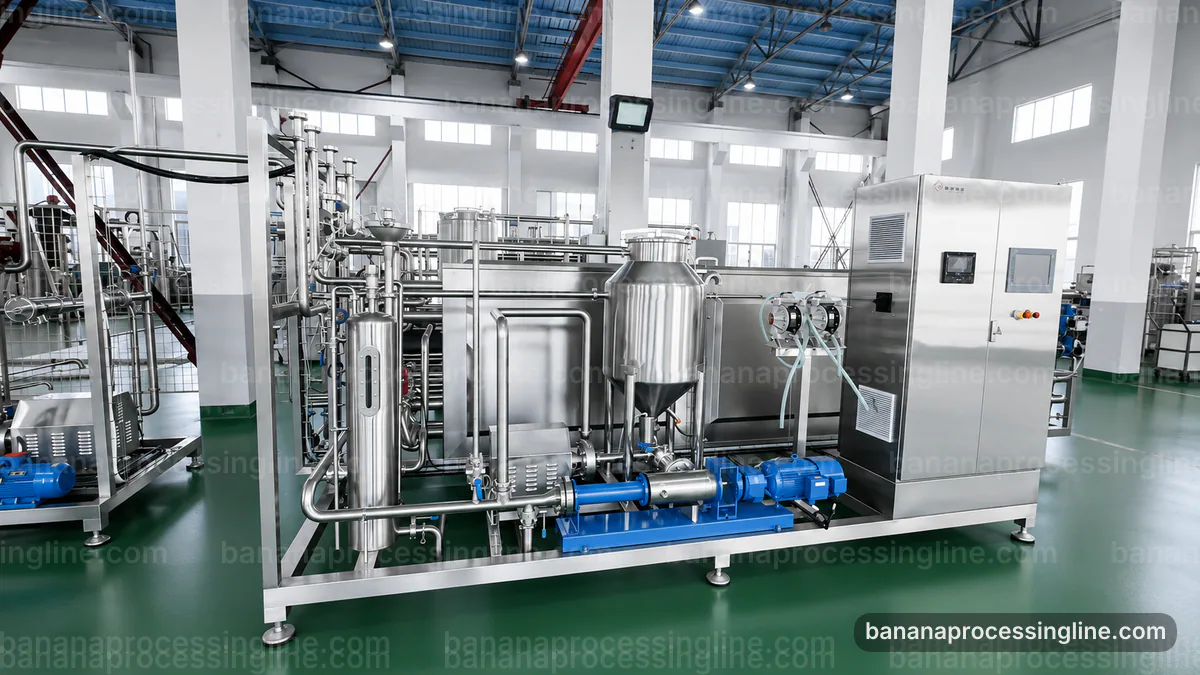
Model and performance data
What is confirmed in the proposal.
Model designation, installed power, dimensions, connection sizes, capacity at the tested condition, material certificates and control scope are issued with the approved general arrangement drawing. A sample trial establishes the product behaviour; it does not guarantee every future lot.
No tank volume, agitation speed or hold time is universal. The offered configuration depends on measured flows, product condition and cleaning validation.
Before you enquire
Questions buyers ask
Do I need a buffer tank in a banana puree line?
Only if the process has a real flow mismatch, a batch requirement or a defined hold. Size it from measured rates and allowable hold time, not from a catalogue volume. A tank can hide an imbalance if the cause is not corrected.
Can I use the same tank for buffering and mixing?
Sometimes, but the duties should be stated separately. Agitation, cleaning, ingredient addition and residence time may conflict. A tank that does both needs a defined process and a trial, not just an agitator added to a buffer.
Does a buffer tank improve food safety?
It can support a controlled process, but it also adds a hold-up point that must be cleaned and monitored. It does not establish sterility or shelf life, and it should not lengthen product exposure without evidence.
How is the working volume calculated?
From the measured flow difference and the allowable hold time, or from the batch size and fill level. The usable volume, headspace and minimum operating level all matter; the nominal vessel size alone is not the answer.