Process flow

Follow the material, including the optional stages.

This chain distinguishes fruit preparation, puree production and downstream modules. Conditions and responsibilities travel with the product.

Choose the entry point

Where does your line begin?

Choose your feed, target texture and downstream objective. The resulting equipment chain is a starting point for a product-specific proposal.

Whole bananas → Smooth puree

Your equipment chain

State whole-fruit input and accepted puree output separately.

  1. PrepareFruit receiving & inspectionUsed for whole-fruit intake; purchased flesh starts at acceptance of the supplied ingredient.
  2. PrepareWhole-fruit washingOmitted when the feed is already peeled banana flesh.
  3. PreparePeeling & flesh inspectionOmitted for purchased flesh. The enquiry distinguishes manual and assisted preparation.
  4. Make pureeFlesh feed & enclosed transferRequired acceptance/feed interface for either raw-material route.
  5. Make pureeBanana pulping machineCore stage for making pulp from flesh; exact configuration depends on the texture target.
  6. Make pureePuree refining & fibre controlRefining intensity is selected for the requested puree or beverage-base specification.
  7. Move & protectViscous puree transfer pumpTransfer duty is required; the exact pump principle and configuration remain project-specific.
  8. ServiceDrain-down & cleaning circuitRequired cleaning scope; manual, dismantling and circulation steps are declared separately.

Confirm the downstream acceptance condition and transfer boundary before selecting post-treatment.

Carry this route into an enquiry ↗

The complete equipment reference

01

Prepare

Fruit receiving & inspection

Keep the raw-material decision visible before equipment capacity is specified.

Input → output
Whole banana lots → Accepted lots with ripeness records
Included when
Used for whole-fruit intake; purchased flesh starts at acceptance of the supplied ingredient.
Interface
Connect receiving to wash-water management and the peeling team. Leave a separate route for rejected fruit and packaging waste.
02

Prepare

Whole-fruit washing

Remove surface contamination before the peel is opened and the flesh enters the clean process.

Input → output
Inspected whole bananas → Washed fruit for peeling
Included when
Omitted when the feed is already peeled banana flesh.
Interface
Coordinate water supply, effluent handling and the elevation to the peeling station. Peels and soil should not travel with prepared flesh.
03

Prepare

Peeling & flesh inspection

Deliver clean flesh at a controlled pace while keeping the actual labour and automation scope explicit.

Input → output
Washed bananas → Inspected peeled flesh and separate peel waste
Included when
Omitted for purchased flesh. The enquiry distinguishes manual and assisted preparation.
Interface
Synchronize the downstream feed hopper with operator output; do not make a tall exposed buffer compensate for an unbalanced station.
04

Make puree

Flesh feed & enclosed transfer

Control exposed hold-up and keep the pulper supplied without packing a viscous feed into an unsuitable inlet.

Input → output
Peeled flesh or accepted purchased flesh → Even feed into size reduction
Included when
Required acceptance/feed interface for either raw-material route.
Interface
Match pulper inlet geometry and low-level control. Purchased-flesh packaging must be opened and removed without contaminating the ingredient.
05

Make puree

Banana pulping machine

Convert flesh into a continuous pulp stream while preserving the texture and thermal basis of the product trial.

Input → output
Controlled banana flesh feed → Mashed pulp for texture refinement
Included when
Core stage for making pulp from flesh; exact configuration depends on the texture target.
Interface
Coordinate the refiner, downstream pump and the possible process-specific preheating position. The order is defined in the validated process proposal.
06

Make puree

Puree refining & fibre control

Reduce unwanted coarse material while keeping recovery, texture and screen loading visible.

Input → output
Mashed pulp → Refined puree and separately measured retained material
Included when
Refining intensity is selected for the requested puree or beverage-base specification.
Interface
Match the puree outlet to a pump that can accept the discharge without starvation. Keep the reject outlet accessible and separate from finished product.
07

Move & protect

Viscous puree transfer pump

Move the actual puree at its operating temperature without substituting a water-based pump rating for product performance.

Input → output
Banana pulp or refined puree → Controlled flow to the selected downstream system
Included when
Transfer duty is required; the exact pump principle and configuration remain project-specific.
Interface
Coordinate the heater or deaerator inlet, bypass arrangements and level control. A pump must not force an unsuitable product into an unverified heat-exchanger passage.
08

Move & protect

Puree deaeration interface

Assess entrained-air removal and oxygen exposure as part of the colour and filling discussion.

Input → output
Pumpable puree at agreed conditions → Puree with air removal assessed in the trial
Included when
Selected when the agreed oxygen/air-control strategy calls for it.
Interface
Match feed pressure, vacuum protection and downstream transfer. Changes in level or temperature must not interrupt the product route.
09

Finish & pack

Viscous-product heat treatment

Select the heat-transfer arrangement around real viscosity, fouling behaviour and the preservation objective.

Input → output
Puree with a defined formulation and flow envelope → Product treated to a separately validated process
Included when
A post-treatment module chosen only after preservation and packaging requirements are defined.
Interface
Treat utilities, product diversion, cooling and the filler boundary as one integration exercise. Thermal equipment alone does not establish an aseptic system.
10

Finish & pack

Bulk filling & package connection

Connect the ingredient to the intended bag, container and distribution route without confusing filling with product preservation.

Input → output
Puree at the agreed filling condition → Filled package within the defined preservation system
Included when
Included when a package and preserved-product route have been confirmed.
Interface
Coordinate upstream capacity, buffering, container movement and operator tasks. State whether the scope ends at the filler or includes handling after filling.
11

Service

Drain-down & cleaning circuit

Design end-of-run handling and cleaning with the same care as steady production.

Input → output
Product-contact equipment after production → A verified clean and ready-to-use system
Included when
Required cleaning scope; manual, dismantling and circulation steps are declared separately.
Interface
Coordinate tanks, pump, heater, filler and drains. A cleaning system must not cross-connect clean product with waste or an unisolated service line.

Move your project forward

Discuss this equipment scope

Start with your raw material, required puree and production basis.

Send a project enquiry ↗

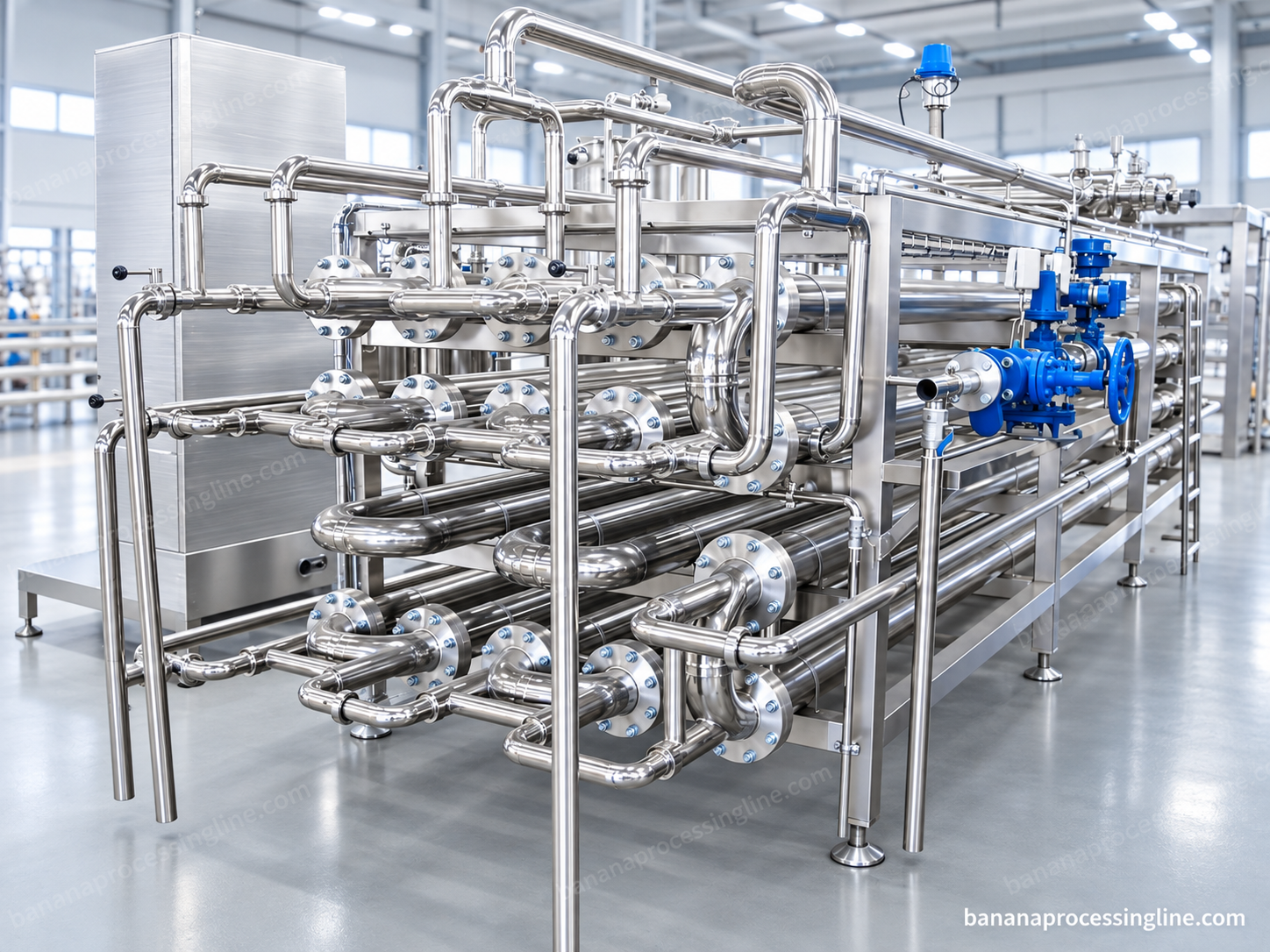
See the selected thermal assembly.

Each customer has different raw materials, texture targets and packaging. We configure the most suitable process from the actual project conditions. Purchased peeled flesh starts after whole-fruit preparation.

  1. Whole bananas
  2. Wash
  3. Peel and inspect
  4. Pulp
  5. Refine
  6. Controlled transfer
  7. Product-specific heat treatment
  8. Filling

No outer enclosure

The selected equipment view shows the exposed tubular heat-treatment assembly requested for this site.

Follow the product conditions

Confirm viscosity, particles, fouling, residence time and package handover. A photograph does not establish thermal performance or shelf life.

Photo-based equipment presentation
Photo-based equipment presentation with AI-refined lighting and background; not a delivered-project record.

Define the actual equipment duty.

Share your incoming material, required product, operating hours and packaging so that the selection can be checked against real conditions.
Discuss this process →
Discuss your banana line ↗