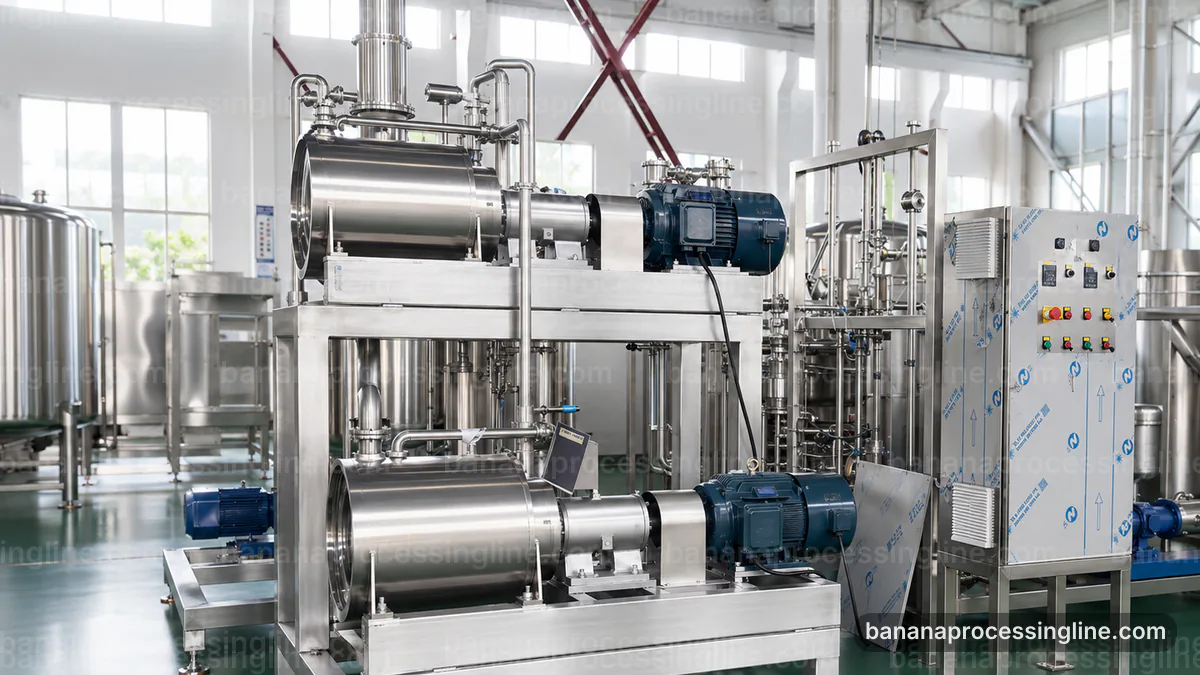
Working principle
How the duty is performed.
Why a second pass exists
The first pass reduces flesh enough to pump and exposes coarse material. A second chamber can work that material further with a different screen or rotor setting. The two stages can be optimized separately instead of forcing one machine to do both jobs.
Avoid overworking the product
More passes mean more energy, more temperature rise and more air exposure. The second stage should have a defined purpose: reduce a specific retained fraction, improve uniformity or protect the refiner from overload. If it cannot be measured, it is hard to justify.
Design the transfer between stages
The intermediate pulp must move without starving the second inlet or creating a new hold-up point. A buffer, pump or gravity chute is selected with the viscosity and layout, not added as an afterthought.
Mechanical composition
What the machine is made of.
A coarse reduction chamber with a screen selected for the initial flesh.
A pump, chute or buffer that moves pulp to the second stage.
A second chamber with its own rotor, screen and drive.
A connection to refining, transfer or the next process step.
Product-contact material grade, surface finish, drive rating and connection sizes are stated on the offered drawing. We do not publish guessed values as verified specifications.
Configuration matrix
Compare the choices, not just the machine name.
| Configuration | Best fit | What changes |
|---|---|---|
| Two chambers in series | A dedicated line with a stable feed and a clear fine-texture target. | Separate control of each pass; more footprint and cleaning. |
| Two-stage with intermediate buffer | A line where the first and second stages run at different paces. | Smoother transfer, but the buffer adds hold-up and exposure. |
| Single stage plus refining | A texture target that can be met by one pulper and a refiner. | Simpler line; the refiner carries more of the texture duty. |
Project data sheet
What to fix before a model is quoted.
| Project parameter | Why it changes the selection | Your value / unit |
|---|---|---|
| First-stage output | Defines the coarse fraction entering stage two | Texture; kg/h |
| Second-stage screen | Controls the final texture and retained material | Aperture |
| Intermediate transfer | Prevents starvation and new hold-up | Pump/chute; residence |
| Temperature rise | Two passes add product work | °C |
| Cleaning time | Both chambers and the transfer must be accessible | Minutes; method |
This is a briefing sheet, not a catalogue specification. The offered model, motor rating, dimensions and connection sizes are issued on the approved drawing.
Banana conditions
What the feed must tell us.
- The coarse fraction left by the first pass.
- Target particle or fibre acceptance method.
- Acceptable temperature rise across two passes.
- Available floor space and cleaning access.
- Whether the second stage runs continuously or by batch.
Process position
Upstream and downstream.
Do not add a second stage to compensate for a worn screen or a feed that is outside the machine's intended range. Fix the first constraint before adding equipment.
Cleaning & access
- Provide independent access to both chambers and screens.
- Drain the intermediate transfer and buffer completely.
- Inspect the second-stage inlet for packed pulp.
Safety & operation
- Interlock both chamber guards.
- Provide a coordinated stop sequence for the two drives and transfer.
- Guard the intermediate transfer and any buffer openings.
Trial & acceptance
- Run the same lot through one stage and then two.
- Compare texture, retained mass, temperature and throughput.
- Check the second stage for overworking or surging.
- Confirm cleaning time for the additional chamber and transfer.
Equipment views
Structure and connections.
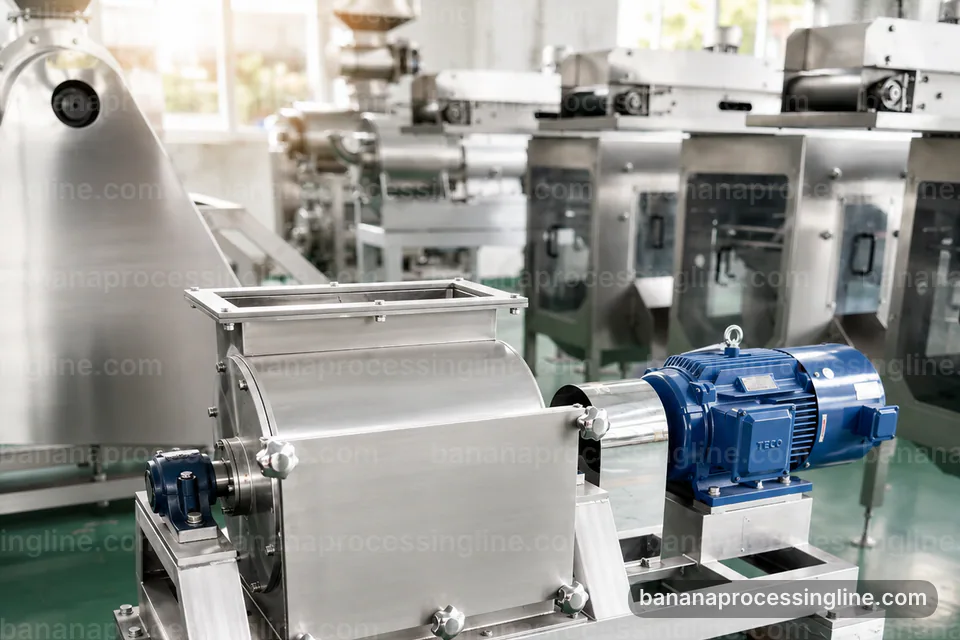
Model and performance data
What is confirmed in the proposal.
Model designation, installed power, dimensions, connection sizes, capacity at the tested condition, material certificates and control scope are issued with the approved general arrangement drawing. A sample trial establishes the product behaviour; it does not guarantee every future lot.
Two stages do not guarantee a finer or better puree; the result depends on the feed, screens, rotors and trial evidence.
Before you enquire
Questions buyers ask
Is two-stage pulping always better?
No. It can improve texture control and recovery for some products, but it adds cost, cleaning and product work. The benefit must be demonstrated against the buyer's reference sample.
Can I add a second stage later?
That depends on the layout, utilities and control architecture. It is usually easier to plan the space and transfer route during the initial project than to retrofit them.
Does two-stage pulping replace refining?
Not necessarily. Pulping reduces flesh; refining makes a separate texture/fibre decision. Some lines use two pulping stages and a refiner; others meet the target with one pulper and a refiner.