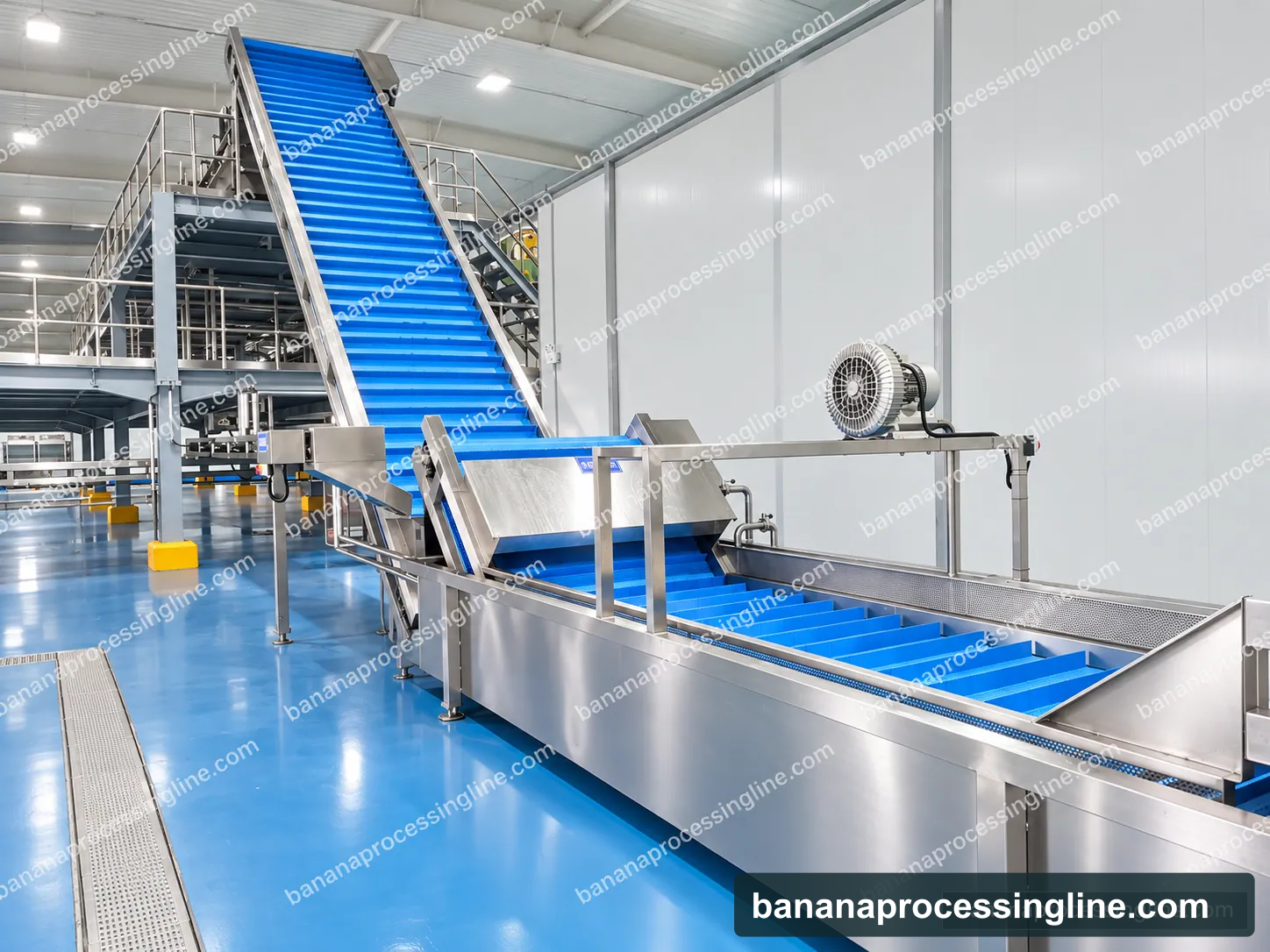
Working principle
How the duty is performed.
Spread, see, decide
The conveyor spreads fruit into a single layer so defects are visible. Belt width and speed are set so operators have enough time to inspect without the fruit piling up or rolling away.
Keep rejects separate
A reject lane or bin must be reachable without crossing the accepted product. The reject route should be sized for the expected defect rate and cleaned on the same schedule as the product area.
Control the handover
The conveyor's discharge should match the next machine's inlet. A surge at the end of the belt can undo the steady inspection pace and overload the washer or peeler.
Mechanical composition
What the machine is made of.
A food-grade belt, roller bed or modular belt with a width that lets operators see the whole fruit.
Diffused, shadow-reduced light over the inspection zone.
Side tables, bins or a short conveyor that keeps rejects away from accepted fruit.
A drive that can be set to the inspection pace rather than only the maximum line rate.
A transfer chute or incline matched to the receiving machine.
Product-contact material grade, surface finish, drive rating and connection sizes are stated on the offered drawing. We do not publish guessed values as verified specifications.
Configuration matrix
Compare the choices, not just the machine name.
| Configuration | Best fit | What changes |
|---|---|---|
| Flat inspection belt | Manual inspection at low to medium throughput. | Simple and accessible; fruit may need to be spread by hand. |
| Roller inspection bed | Fruit that should be turned for a full surface view. | Better visibility, with more moving parts and nip points to guard. |
| Inspection with grading lanes | Lots that are separated by ripeness or size before processing. | More decisions and lanes; requires a clear destination for each grade. |
| Peeled-flesh inspection belt | Purchased flesh that needs a final visual check before feeding. | Hygienic belt and enclosure become more important; fruit-specific brushes are removed. |
Project data sheet
What to fix before a model is quoted.
| Project parameter | Why it changes the selection | Your value / unit |
|---|---|---|
| Belt width and speed | Sets operator reach and inspection time | mm; m/min |
| Defect scope | Determines lighting, lanes and reject destinations | Description |
| Operators per shift | Sizes the inspection positions and walkway | Number |
| Whole fruit or flesh | Changes the hygiene boundary and belt type | Route |
| Discharge height | Matches the next machine inlet | mm |
This is a briefing sheet, not a catalogue specification. The offered model, motor rating, dimensions and connection sizes are issued on the approved drawing.
Banana conditions
What the feed must tell us.
- Whole fruit or peeled flesh; the hygiene boundary changes.
- Expected defect rate and the reason for each rejection.
- Number of operators and the reachable belt width.
- Required handover height to the next machine.
- Whether lot traceability needs a record at inspection.
Process position
Upstream and downstream.
Place the conveyor where the reject decision is most useful. Inspecting after washing can reveal damage that was hidden by soil; inspecting before washing reduces contaminated fruit entering the washer.
Cleaning & access
- Remove fruit residues from the belt, rollers and reject lanes.
- Inspect belt edges and return paths where debris collects.
- Clean lighting covers without leaving chemical residue over product.
Safety & operation
- Guard tail pulleys, drive chains and any roller nip points.
- Provide emergency stops along the inspection length.
- Keep reject bins from blocking the operator's walkway.
Trial & acceptance
- Run a representative lot at the intended inspection speed.
- Record how many fruit an operator can inspect per minute without losing accuracy.
- Check the reject lane capacity over a full shift.
- Confirm the discharge does not bruise or jam at the next machine.
Equipment views
Structure and connections.
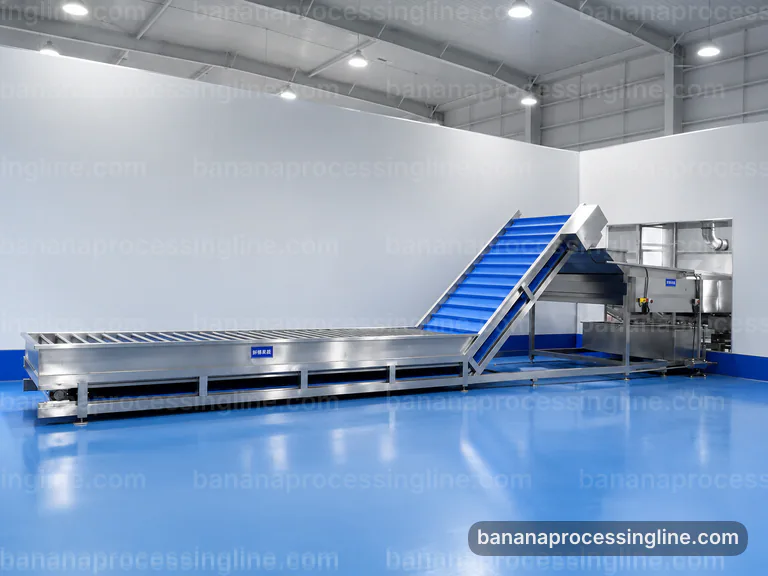
Model and performance data
What is confirmed in the proposal.
Model designation, installed power, dimensions, connection sizes, capacity at the tested condition, material certificates and control scope are issued with the approved general arrangement drawing. A sample trial establishes the product behaviour; it does not guarantee every future lot.
A conveyor provides the inspection position; it does not establish a grading specification or a food-safety outcome.
Before you enquire
Questions buyers ask
Do I need a separate sorting conveyor if I already have a receiving table?
Not always. If receiving already provides enough space, lighting and reject access, a second conveyor may add handling without adding control. The decision depends on throughput and the defect scope.
Can the conveyor grade by ripeness?
It can provide lanes for operators to make that decision. Automatic grading by colour or firmness is a different scope and must be specified with its own validation.
Where should inspection happen in a whole-fruit line?
Usually after receiving and before peeling, with a second check of peeled flesh. Some lines also inspect after washing. The right positions depend on where defects become visible.